Curriculum Writing
I would call myself "traditional" and "very conservative" in just about all aspects of my personality.
However, for the last several days I have been working on writing the biology curriculum for my school district and I have noticed that I am a bit progressive in my thinking when education is concerned.
I remember hashing out with a colleague years ago about how teaching a biology course in a contextual or thematic method would work. We decided that it would take a lot of work restructuring the curriculum and there was a lot to think about in moving major elements of the course around. But today, I think we came upon a method that moved us in that direction with warp-speed quickness.
Let me explain.
Biology traditionally has had rather "stand alone units". "Biochemistry" was one unit... then "The Cell", then "Cell Boundaries", then "Photosynthesis", then "Cellular Respiration", then "Cell Division", then "Molecular Genetics". then "Mendelian Genetics".... etc.....
 Each concept, although completely related to the biological scholar, seemed to be islands floating in a mental spaghetti bowl to the embryonic mind of a high school student.
We remedied some of that today.
Ironically, the catalyst for all this was the despised TAKS test.
People have defined "insanity" as doing the same thing over and over and expecting different results. I don't know where people came up with that definition because my dictionaries don't define it that way..... but for the sake of making the case for causing change to happen; I guess that definition works.
Our school district has 62,000 students, putting it in the top-ten largest school districts in Texas. That's quite a bunch of minds we are responsible for teaching. I had a very difficult time seeing how we were going to sell this concept to a very large pool of biology teachers who liked being able to follow the book in line with the way the publishers and tradition dictated and use the structure of the ancillaries as complete and linear documents.
Now, in my personal life I am well known for making quick, and sudden decisions that appear on the outside to be reactionary. But on the inside I have already hashed out the pros and cons... I just don't move slowly in making the final decision. But today, I think I was the "voice of reason", moving VERY cautiously. It took some convincing to make me agree that this revolutionary curricular move could be made in OUR school district (known for being afraid of making waves).
We aren't going to follow tradition this time, and although our decision today was not a whole-scale thematic approach, it will turn the existing curriculum topsy-turvy.
I kept telling my colleagues (two of whom are not in the classroom any longer and one who has just accepted a position in another school district) that we would have to prepare for the aftermath of presenting this new curriculum to the biology teachers and that for the majority it would not be an "easy sell".
Since I am the only one on the curriculum committee who is actually still IN the classroom, my name will be on the document and I will feel the brunt of the response from my fellow teachers. I wanted to make sure we weren't screwing things up (like the sequence) for everybody.
But the more I think about it, the more and more I like what we have done. I would like to push more in that direction.... but I think the baby-steps we have taken today are revolutionary enough.
Here are the major changes we made just today:
1) The tradition "Cell" unit is gone. There will be no teaching the cell structure and organelles in mass in one chapter. The cell will simply be introduced and then all organelles will be taught in context with the topic that relates to them most.
 For example: smooth and rough ER and ribosomes will be taught in the protein synthesis portion of the molecular genetics unit; the chloroplast will be taught when we teach photosynthesis, the vacuole will be taught when we teach osmosis, the centriole will be taught when we teach mitosis.....
However, for the last several days I have been working on writing the biology curriculum for my school district and I have noticed that I am a bit progressive in my thinking when education is concerned.
I remember hashing out with a colleague years ago about how teaching a biology course in a contextual or thematic method would work. We decided that it would take a lot of work restructuring the curriculum and there was a lot to think about in moving major elements of the course around. But today, I think we came upon a method that moved us in that direction with warp-speed quickness.
Let me explain.
Biology traditionally has had rather "stand alone units". "Biochemistry" was one unit... then "The Cell", then "Cell Boundaries", then "Photosynthesis", then "Cellular Respiration", then "Cell Division", then "Molecular Genetics". then "Mendelian Genetics".... etc.....
 Each concept, although completely related to the biological scholar, seemed to be islands floating in a mental spaghetti bowl to the embryonic mind of a high school student.
We remedied some of that today.
Ironically, the catalyst for all this was the despised TAKS test.
People have defined "insanity" as doing the same thing over and over and expecting different results. I don't know where people came up with that definition because my dictionaries don't define it that way..... but for the sake of making the case for causing change to happen; I guess that definition works.
Our school district has 62,000 students, putting it in the top-ten largest school districts in Texas. That's quite a bunch of minds we are responsible for teaching. I had a very difficult time seeing how we were going to sell this concept to a very large pool of biology teachers who liked being able to follow the book in line with the way the publishers and tradition dictated and use the structure of the ancillaries as complete and linear documents.
Now, in my personal life I am well known for making quick, and sudden decisions that appear on the outside to be reactionary. But on the inside I have already hashed out the pros and cons... I just don't move slowly in making the final decision. But today, I think I was the "voice of reason", moving VERY cautiously. It took some convincing to make me agree that this revolutionary curricular move could be made in OUR school district (known for being afraid of making waves).
We aren't going to follow tradition this time, and although our decision today was not a whole-scale thematic approach, it will turn the existing curriculum topsy-turvy.

I kept telling my colleagues (two of whom are not in the classroom any longer and one who has just accepted a position in another school district) that we would have to prepare for the aftermath of presenting this new curriculum to the biology teachers and that for the majority it would not be an "easy sell".
Since I am the only one on the curriculum committee who is actually still IN the classroom, my name will be on the document and I will feel the brunt of the response from my fellow teachers. I wanted to make sure we weren't screwing things up (like the sequence) for everybody.
But the more I think about it, the more and more I like what we have done. I would like to push more in that direction.... but I think the baby-steps we have taken today are revolutionary enough.
Here are the major changes we made just today:
1) The tradition "Cell" unit is gone. There will be no teaching the cell structure and organelles in mass in one chapter. The cell will simply be introduced and then all organelles will be taught in context with the topic that relates to them most.
For example: smooth and rough ER and ribosomes will be taught in the protein synthesis portion of the molecular genetics unit; the chloroplast will be taught when we teach photosynthesis, the vacuole will be taught when we teach osmosis, the centriole will be taught when we teach mitosis.....I fought this at first. It seemed that the others weren't thinking things through. So I made the point that if we were going to do it at all, then we would HAVE to do it completely, not leave organelles hanging willy-nilly here and there. That if we were convinced that this is how we were going to teach the cell then we would have to be consistent in this new approach.
My caution was because this completely eliminates the traditional few weeks we spend on teaching cell organelles (all at once) and drawing, coloring and labeling the cell, making a cell model out of Styrofoam or jello.... or whatever. For some teachers, this is like editing the Bible. They live for their edible cell model or their Styrofoam project complete with macaroni, plastic beads and pipe cleaners.
We are working on overlay transparencies or a power point sequence that will take a generic "empty" cell diagram and overlay a new image on top of the bottom image that adds an organelle when that organelle is taught.
By the end of the year, the whole cell will be taught.... just spread throughout and then reviewed before the end of the course.
2) The Plant
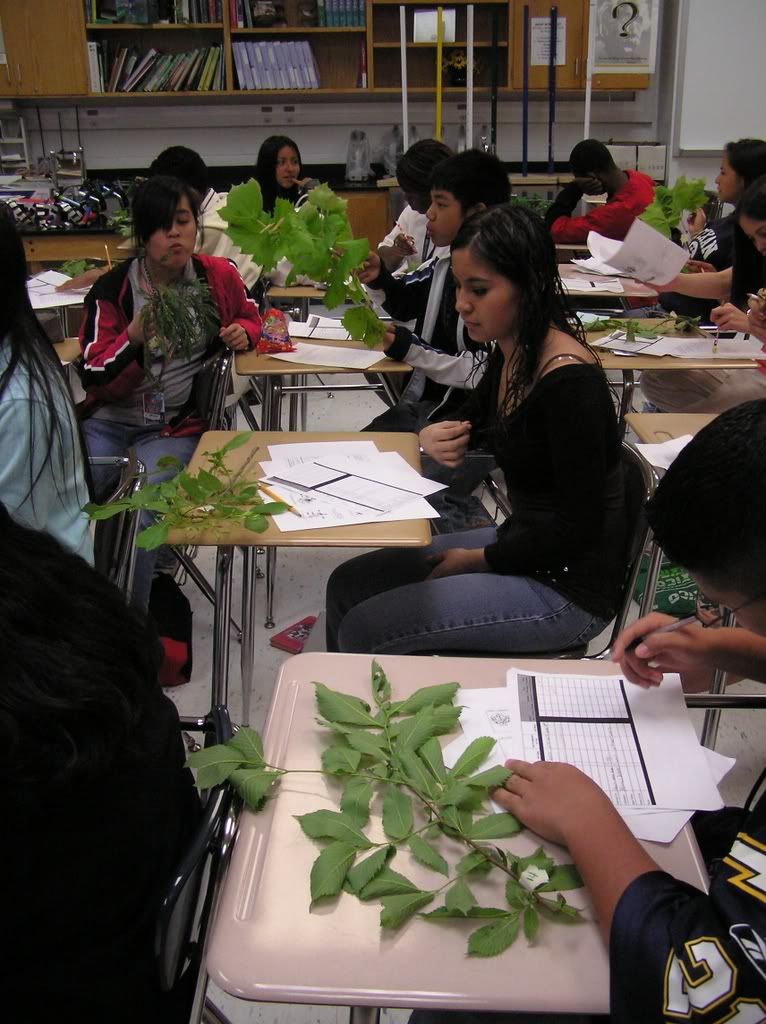
Arguably, plants are among the most important organisms on the planet. They are the reasons all living things exist. With the current biology curriculum, plants are ignored. Some teachers completely skip the plant kingdom in haste to make time for the animal kingdom and dissections (the quintessential high school experience in biology). Our plan, was to include plants all year by making recurrent examples of them and then NOT having a plant unit to teach or to ignore.
How we did it:
The first real movement in the curriculum in regards to the way we teach plants was in the biochemistry unit. When polarity of water (adhesion, cohesion and capillary action) is taught, we will teach at the same time xylem of stems and transpiration. This is a real example with applications of the properties of water that the kids can grasp early on and make mental connections.

Currently xylem is taught in the second semester (if at all) in a section of the plant unit called "the stem". Most teachers don't teach this depth at all because they are running out of time at the end of the semester. This change will make this topic move to the first six weeks of school.
We hit plants again in photosynthesis where we teach the gas exchange structures of the stomata, and the structure of the leaf. Here we will also teach sugar being a product of photosynthesis and being conducted away from the leaf to the root via phloem in the stem.
The depth of photosynthesis will be depleted and replaced with breadth. NO more teaching light reactions and dark reactions and electron transport.... now it is all about the "big picture". The scope has broadened to expand the context... but the nit-picky details removed. This unit should take about the same amount of time that the old Calvin cycle and reactions method used to take.
Our philosophy in doing this is that when students learn something in context, with examples that make sense they will retain it better than teaching it in a lump with no contextual reference. The old way makes sense to the teacher, because we have a biology degree and know where things should fit.... to a student, it is all just a big mish-mosh of vocabulary without a context-- because the subject is not taught with enough depth in high school to really see how it all fits together.

Anyway, that's what I have been doing lately. They paid me, so all the sweat and tears are not in vain.
You can email me or slip a comment at the bottom of this post to let me know your opinion.....





 My StumbleUpon Page